

How Do You Become a Faster Dentist?
Nov 03, 2020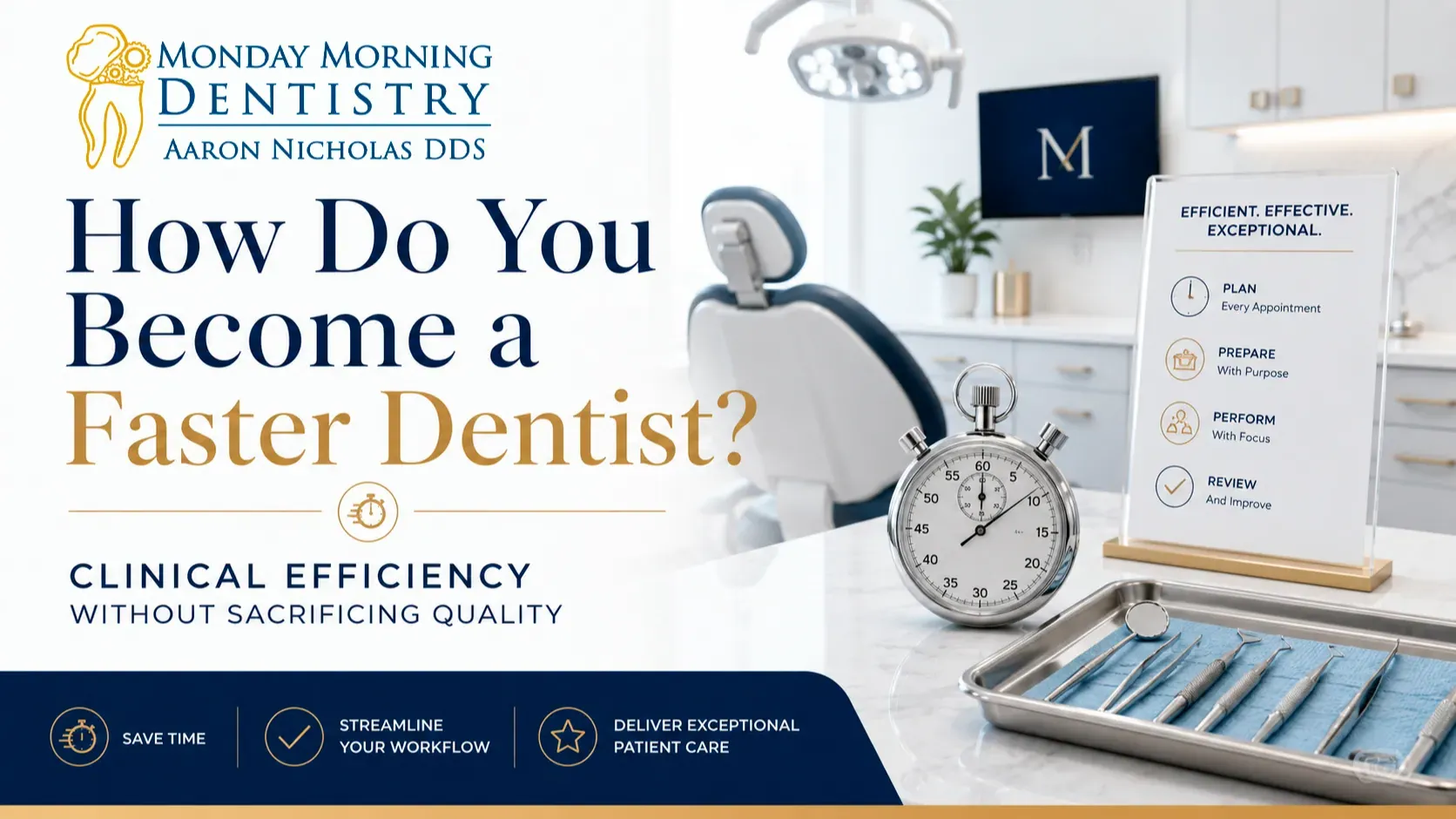
I get asked all the time about how to “get faster.”
Speed Is Not the Goal
To be honest, this question always makes me cringe a bit. Speed is a noble goal, but only if it is not accompanied by a reduction in quality.
The way I see it, my first responsibility is to be almost perfect. As dentists, we are asked day in and day out to work in a highly stressful environment and produce “perfect” outcomes eight hours a day, for as many days as we decide to work each week.
It’s almost impossible.
However, we actually do this on a fairly regular basis. Every time a patient comes back after treatment to complain about a less-than-perfect outcome, what they are really saying is that they expected you to be perfect.
It’s an amazing compliment and an unrealistic burden.
Efficiency and Quality Can Work Together
But efficiency and high quality do not have to be exclusive of each other. Many times, they are actually connected.
I can perform a root canal, build-up, and crown in an hour and a half in the middle of my day with almost no problem. But move that procedure to the end of the day, where I don’t necessarily need to be right on schedule, and I have trouble finishing and getting my staff home on time.
Why?
As Cyril Northcote Parkinson observed years ago, “Work expands to fill the time allotted, usually without an increase in the quality of results.”
A lot of what is going on has to do with the dentist’s mindset of when good enough is enough. Will working on this aspect of the treatment yield a better result, or are we just satisfying our own neurosis?
Don’t get me wrong. I like creating perfect and beautiful outcomes. And I love getting better results because of efficiency.
I live for that moment when we finish a procedure and the patient looks up and says, “That’s it? If I knew it was going to be this easy, I would have done this years ago!”
But the hero can quickly turn into the donkey if our “speed” ends up with the patient receiving a poorer result than expected.
So what we are really looking for is not simply speed. We are looking for ways to become hyper-efficient.
The Problem With Being Fast at the Wrong Thing
But there are pitfalls here as well. We can become hyper-efficient at a process that produces the wrong result.
Get a ladder. Put it up against a wall. Get really good at climbing the ladder. Amazing. You’re the best.
But if the ladder is leaning against the wrong wall, you’ve accomplished nothing.
Yes, you’re fast. Yes, you’re hyper-efficient. You’re the fastest at getting to the top of the ladder.
But it’s against the wrong wall.
You’re hyper-efficient at the wrong outcome.
Oops.
Speed Should Be the Byproduct
So what we really need to do is figure out our best outcome first. Then we need to identify all the necessary steps that get us to that outcome. After that, we eliminate everything that does not directly contribute to accomplishing that goal.
Now we can become hyper-efficient in a meaningful way.
Most importantly, now speed comes as a byproduct.
That is the way I want to be faster.
In this series, we’ll explore the general principles that can help make procedures in the dental office more efficient without sacrificing quality.
We’ll also look at how these principles apply to some of the most common procedures in general dentistry.
