

How Do You Perform Efficient (and Profitable) Extractions?
Nov 03, 2020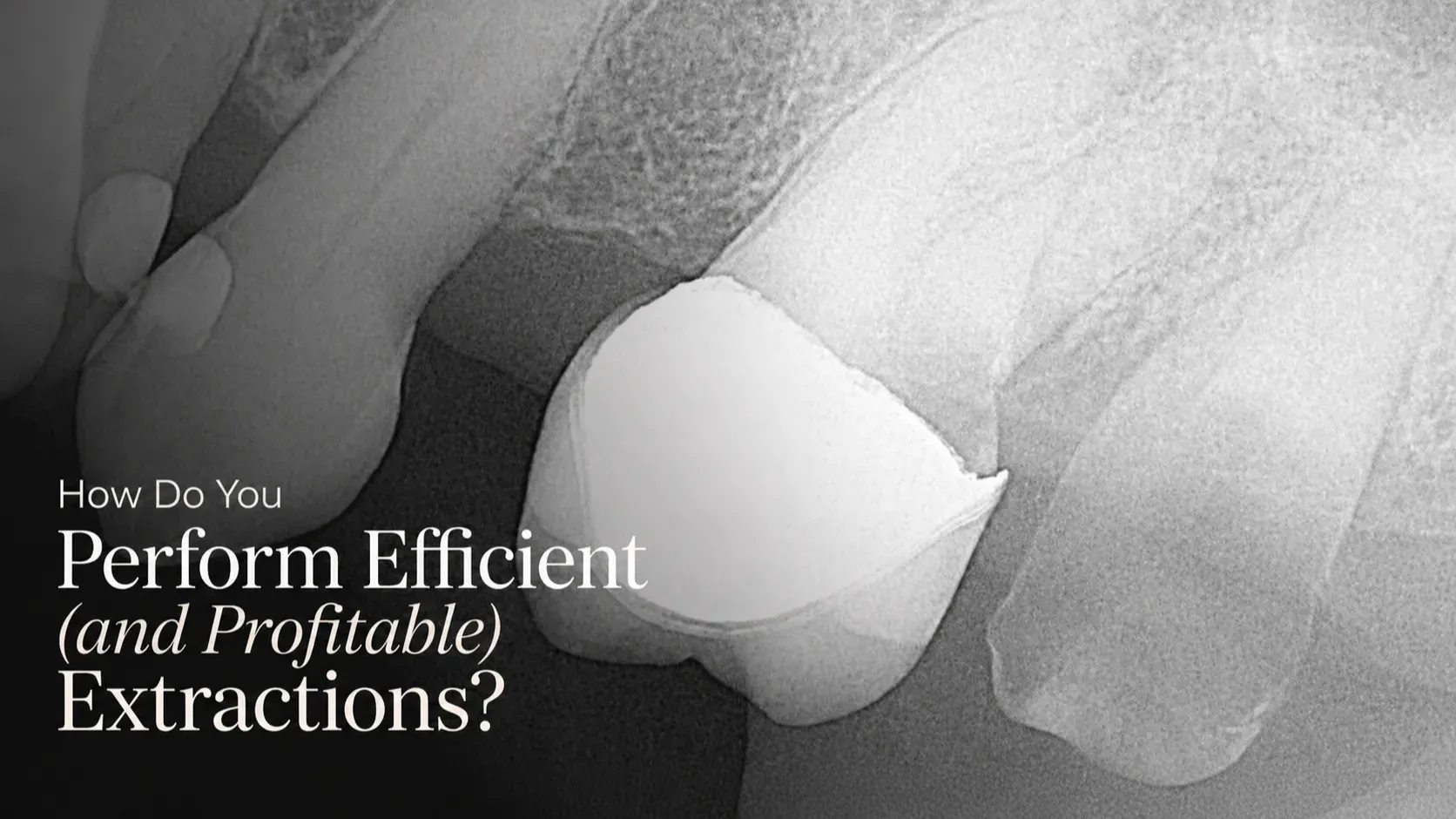


Using the same general efficiency principles, of course.
This case involved a large buccal carious lesion on #14 and a completely decayed crown on #15. So, there was no real chance to rely on forceps here.
To be fair, most of the time I’m sectioning and extracting individual roots with maxillary first molars anyway. It gives me more control, and I’m not digging for root tips in the last third of the root.
Efficiency Principle #1
When you pick up an instrument, use it to completion on all teeth you’re working on before putting it back down.
Handpiece, elevator, luxator — it doesn’t matter. Plan the work so this can happen. A lot of time is wasted switching back and forth between instruments.
So #15 just needs to be elevated out. I also want to remove #15 before #14 so that if a root fractures, #14 isn’t bleeding into the socket of #15 while I’m trying to remove the root tip.
However, if I start with #15, then I’ll use an elevator or luxator and put it down before working on #14. I also run the risk that debris from removing the crown on #14 ends up in the socket of #15.
Instead, I’ll start with #14. Once I have an elevator or luxator in hand, I’ll remove #15 first, then #14.
The Procedure
Remove the crown. Cut the remaining tooth structure to about 2 mm above the soft tissue. Remove loose caries on both teeth.
Section tooth #14. Elevate the roots out, starting with #15. Bone graft and suture both sites.
All done.
No back and forth. Everything is used once and completed before moving on.
Total treatment time after the patient was numb was 20 minutes.
Efficient and profitable.
